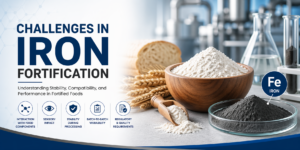
Understanding Stability, Compatibility, and Performance in Fortified Foods
🔹 Introduction
Food fortification is widely recognized as an effective strategy to address iron deficiency at scale. However, implementing successful fortification programs is not without challenges.
Iron, while essential, is a reactive element, and its interaction with food systems can affect product quality, stability, and consumer acceptance. The success of any fortification initiative depends not only on adding iron, but on selecting a form of iron that performs reliably under real-world conditions.
🔹 Why Iron Fortification is Challenging
Unlike many other nutrients, iron interacts actively with food components and environmental conditions. These interactions can lead to:
- Changes in taste and color
- Reduced stability during storage
- Variability in nutrient delivery
- Processing-related challenges
These factors make iron fortification a technically sensitive process, requiring careful ingredient selection and process control.
🔹 Key Challenges in Iron Fortification
1. Interaction with Food Components
Iron can react with fats, moisture, and other ingredients present in food systems.
This may lead to:
- Oxidation reactions
- Development of off-flavors
- Changes in product appearance
These interactions are particularly important in products with higher fat content or complex formulations.
2. Sensory Impact (Taste, Color, Texture)
One of the most common challenges in fortification is maintaining the original sensory profile of the food.
Poorly controlled iron sources can cause:
- Metallic taste
- Darkening or discoloration
- Texture variations
For consumer acceptance, it is critical that fortified foods retain their original sensory characteristics.
3. Stability During Processing
Food processing conditions such as:
- Heat
- Moisture
- Mixing
- Storage
can influence the behavior of iron.
Iron must remain stable throughout:
- Production
- Packaging
- Shelf life
Instability can lead to reduced effectiveness and inconsistent product performance.
4. Batch-to-Batch Variability
In large-scale manufacturing, consistency is critical.
Variability in iron powder can result in:
- Uneven nutrient distribution
- Differences in product quality
- Production inefficiencies
This makes batch consistency and process control essential.
5. Regulatory and Quality Requirements
Iron used in food must meet strict regulatory standards, including:
- Control of heavy metals (Pb, As, Hg, Cd)
- Defined purity levels
- Compliance with food-grade frameworks
Failure to meet these requirements can impact product approval and market access.
🔹 Role of Iron Powder Quality in Overcoming Challenges
Many fortification challenges can be addressed through the selection of a well-controlled iron source.
High-quality iron powders are designed to:
- Minimize unwanted reactions
- Maintain stability during processing and storage
- Deliver consistent performance across batches
- Support compliance with regulatory standards
The manufacturing process plays a key role in achieving these characteristics.
🔹 Importance of Manufacturing Route
Iron powders that appear similar may behave very differently depending on how they are produced.
Manufacturing route influences:
- Impurity profile
- Surface condition
- Chemical stability
- Batch consistency
Processes such as electrolytic refinement allow better control over these factors, helping reduce variability and improve reliability in fortification systems.
🔹 Practical Approach to Managing Challenges
To ensure successful fortification, manufacturers should focus on:
- Selecting iron powders with controlled purity and consistency
- Evaluating compatibility with specific food systems
- Testing performance under actual processing conditions
- Working with suppliers who provide technical support and documentation
A process-driven approach helps minimize risks and improve long-term outcomes.
🔹 Conclusion
Iron fortification is not just about adding a nutrient — it is about ensuring that the nutrient performs effectively within a complex food system.
Understanding the challenges associated with iron and addressing them through proper material selection and process control is key to achieving consistent, stable, and acceptable fortified products.