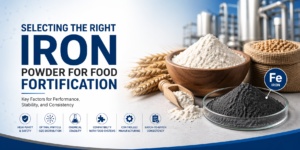
Key Factors for Performance, Stability, and Consistency
🔹 Introduction
The success of any food fortification program depends not only on the inclusion of iron, but on selecting the right type of iron powder for the specific application.
Different iron powders can vary significantly in their behavior, stability, and compatibility with food systems. Choosing an unsuitable iron source can lead to issues in product quality, processing, and long-term performance.
This makes iron selection a critical technical decision, not just a procurement choice.
🔹 Why Iron Selection Matters
Iron powders may appear visually similar, but their performance is influenced by:
- Manufacturing route
- Purity and impurity profile
- Particle size distribution
- Surface condition and stability
These factors determine how iron behaves during:
- Mixing
- Processing
- Storage
- Final consumption
Selecting the right iron powder ensures consistent and reliable fortification outcomes.
🔹 Key Factors to Consider When Selecting Iron Powder
1. Purity and Impurity Control
High-purity iron is essential for both safety and performance.
Key considerations include:
- Iron content (Fe %)
- Control of safety-critical heavy metals (Pb, As, Hg, Cd)
- Low acid-insoluble content
Well-controlled impurity profiles support regulatory compliance and product stability.
2. Particle Size Distribution
Particle size affects:
- Mixing uniformity
- Flow behavior
- Distribution in food matrices
Consistent particle size ensures:
- Even nutrient distribution
- Stable processing behavior
- Predictable product quality
3. Chemical Stability
Iron must remain stable during:
- Food processing (heat, moisture)
- Storage and shelf life
Stable iron powders help:
- Prevent unwanted reactions
- Maintain product quality
- Ensure consistent nutrient delivery
4. Compatibility with Food Systems
Iron should integrate into food without affecting:
- Taste
- Color
- Texture
Compatibility depends on:
- Surface condition of the iron
- Impurity levels
- Interaction with other ingredients
5. Manufacturing Route
The method used to produce iron powder is one of the most important factors.
Manufacturing route determines:
- Purity level
- Impurity control
- Surface characteristics
- Batch consistency
Processes such as electrolytic refinement offer better control over these parameters compared to conventional methods.
6. Batch-to-Batch Consistency
For industrial food production, consistency is critical.
Reliable iron powders should offer:
- Uniform chemical composition
- Stable particle size
- Reproducible performance
This ensures smooth production and consistent product quality.
🔹 Role of Process-Controlled Iron Powders
Iron powders produced through controlled manufacturing processes are better suited for fortification applications.
These powders provide:
- Consistent purity levels
- Controlled impurity profiles
- Stable behavior across batches
- Reliable performance in food systems
This reduces variability and improves long-term program reliability.
🔹 Practical Approach to Selection
When selecting iron powder for fortification:
- Evaluate technical specifications (purity, particle size, impurities)
- Consider application-specific requirements
- Conduct trials under actual processing conditions
- Work with suppliers who provide documentation and technical support
A structured evaluation approach helps ensure the selected iron powder meets both technical and regulatory requirements.
🔹 Conclusion
Selecting the right iron powder is essential for the success of food fortification programs. The decision should be based on quality, consistency, and manufacturing control, rather than appearance or cost alone.
By focusing on process-driven materials and well-defined specifications, manufacturers can achieve reliable, stable, and effective fortification outcomes.