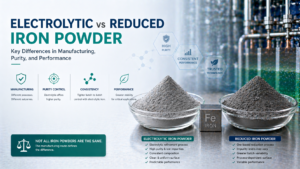
Key Differences in Manufacturing, Purity, and Performance
🔹 Introduction
Iron powders are widely used across food fortification, nutritional premixes, dietary supplements, and industrial applications. Among the commonly used types are electrolytic iron powder and reduced iron powder.
While both materials may appear similar visually, their manufacturing processes, impurity profiles, and performance characteristics can differ significantly. Understanding these differences is essential for selecting the right iron powder for a specific application.
🔹 What is Electrolytic Iron Powder?
Electrolytic iron powder is produced through a purification-driven electrochemical process, where iron is deposited from a solution onto a cathode.
This method:
- Separates iron from impurities at a fundamental level
- Produces a highly refined and controlled iron base
- Enables consistent chemical composition across batches
Electrolytic iron is commonly used in applications where purity and consistency are critical.
🔹 What is Reduced Iron Powder?
Reduced iron powder is typically produced by reducing iron ore using gases such as hydrogen or carbon monoxide.
This process:
- Converts iron oxide into metallic iron
- Retains characteristics influenced by raw material sources
- May result in variability depending on ore quality and process control
Reduced iron is widely used in various applications, including industrial processes and some nutritional uses.
🔹 Key Differences Between Electrolytic and Reduced Iron Powder
1. Manufacturing Process
- Electrolytic Iron Powder
Produced through electrochemical refinement, focusing on purification. - Reduced Iron Powder
Produced by reducing iron ore, influenced by raw material variability.
2. Purity and Impurity Control
- Electrolytic Iron
Offers tighter control over impurities and heavy metals. - Reduced Iron
Impurity levels may vary depending on ore source and reduction process.
3. Chemical Consistency
- Electrolytic Iron
Highly consistent batch-to-batch composition. - Reduced Iron
Greater variability across batches.
4. Surface Characteristics
- Electrolytic Iron
Clean and controlled surface condition. - Reduced Iron
Surface properties influenced by reduction process.
5. Stability and Performance
- Electrolytic Iron
More predictable behavior in food and nutritional systems. - Reduced Iron
May show variability depending on processing and storage conditions.
🔹 Summary Comparison Table
| Parameter | Electrolytic Iron Powder | Reduced Iron Powder |
| Manufacturing | Electrochemical refinement | Ore-based reduction |
| Purity Control | High | Moderate |
| Impurity Profile | Controlled | Variable |
| Consistency | High | Variable |
| Surface Condition | Clean and uniform | Process-dependent |
| Stability | Predictable | Variable |
🔹 Why Manufacturing Route Matters
Iron powder quality is not defined by appearance — it is defined by how the material is produced.
Manufacturing route determines:
- Purity level
- Impurity profile
- Surface characteristics
- Batch consistency
These factors directly influence how iron behaves in real-world applications.
🔹 Application Considerations
Food Fortification & Nutrition
Applications require:
- Controlled purity
- Stability
- Consistent performance
Electrolytically refined iron is often preferred in these systems due to its predictability and impurity control.
Industrial Applications
Requirements may vary depending on:
- Reaction conditions
- Process sensitivity
Both types of iron powder may be used depending on the application.
🔹 Choosing the Right Iron Powder
Selection should be based on:
- Application requirements
- Processing conditions
- Stability needs
- Regulatory expectations
Rather than relying on appearance or cost alone, it is important to evaluate manufacturing method and material behavior.
🔹 Conclusion
Electrolytic iron powder and reduced iron powder differ significantly in terms of manufacturing process, purity, and consistency.
For applications where performance, stability, and reliability are critical, understanding these differences is essential. Choosing the right iron powder ensures better process outcomes, product quality, and long-term consistency.