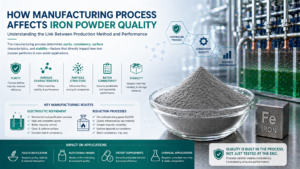
Understanding the Link Between Production Method and Performance
🔹 Introduction
Iron powder quality is not defined only by its chemical composition or appearance. The manufacturing process plays a fundamental role in determining how iron powder behaves in food, nutritional, and industrial applications.
Two iron powders with similar specifications may perform very differently depending on how they are produced. Understanding this relationship helps manufacturers select materials that deliver consistent and reliable results.
🔹 Why Manufacturing Process Matters
The production route determines:
- Purity and impurity profile
- Surface condition of particles
- Particle structure and morphology
- Stability during storage
- Batch-to-batch consistency
These factors directly influence how iron powder performs in real-world applications.
🔹 Key Manufacturing Routes for Iron Powder
1. Electrolytic Refinement
Electrolytic iron powder is produced through an electrochemical process that separates iron from impurities at a fundamental level.
Impact on quality:
- High and consistent purity
- Tight control of heavy metals
- Clean and uniform particle surface
- Excellent batch consistency
This route is commonly used where reliability and impurity control are critical.
2. Reduction Processes
Reduced iron powder is typically produced by reducing iron ore using gases such as hydrogen or carbon monoxide.
Impact on quality:
- Properties influenced by raw material source
- Greater variability in impurity profile
- Surface characteristics dependent on reduction conditions
- Batch consistency may vary
This route is widely used in both industrial and some nutritional applications.
🔹 How Process Influences Key Quality Parameters
🔸 1. Iron Purity
Manufacturing determines how effectively impurities are removed.
- Purification-based processes → Higher purity
- Ore-based processes → Dependent on raw material quality
🔸 2. Impurity Profile
Trace elements such as lead, arsenic, mercury, and cadmium must be tightly controlled in food and nutrition applications.
- Controlled refinement → Better impurity management
- Variable raw materials → Greater variability
🔸 3. Surface Characteristics
Surface condition affects:
- Reactivity
- Stability
- Interaction with other ingredients
Processes such as hydrogen reduction can further refine surface properties and improve uniformity.
🔸 4. Particle Structure
Manufacturing affects:
- Particle shape
- Internal structure
- Mechanical properties
These factors influence how iron powder behaves during:
- Mixing
- Compression
- Processing
🔸 5. Batch-to-Batch Consistency
Consistency is critical for large-scale production.
- Controlled processes → Repeatable results
- Variable inputs → Inconsistent performance
🔹 Impact on Applications
Food Fortification
Requires:
- Controlled purity
- Stability during storage
- Minimal interaction with food matrix
Manufacturing consistency ensures reliable fortification outcomes.
Nutritional Premix
Requires:
- Uniform blending
- Consistent particle size
- Stable composition
Process control is essential for homogeneous mixing and long shelf life.
Dietary Supplements
Requires:
- Predictable behavior during formulation
- Stability in tablets and capsules
Manufacturing route influences processing efficiency and product quality.
Chemical Applications
Requires:
- Controlled reactivity
- Consistent chemical composition
Variations in manufacturing can directly impact reaction outcomes.
🔹 Process Control vs End Testing
Quality is often misunderstood as something verified only through testing.
At a deeper level:
- End-product testing confirms quality
- Process control creates quality
Manufacturers that focus on process control are able to deliver:
- More consistent products
- Lower variability
- Better long-term reliability
🔹 Why This Matters for Buyers
Selecting iron powder based only on:
- Price
- Appearance
- Basic specifications
can lead to inconsistent results.
Instead, buyers should evaluate:
- Manufacturing method
- Process control systems
- Consistency over time
🔹 Conclusion
The manufacturing process is the foundation of iron powder quality. It determines purity, consistency, surface characteristics, and overall performance.
Understanding how iron powder is produced allows manufacturers to make informed decisions and select materials that deliver reliable, repeatable outcomes across applications.