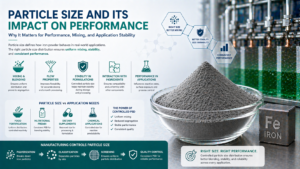
Why It Matters for Performance, Mixing, and Application Stability
🔹 Introduction
Particle size is one of the most important physical characteristics of iron powder. While chemical composition defines what the material is, particle size influences how the material behaves in real-world applications.
In food fortification, nutritional premixes, dietary supplements, and chemical processes, particle size plays a key role in ensuring uniformity, stability, and consistent performance.
🔹 What is Particle Size in Iron Powder?
Particle size refers to the distribution of individual iron particles within a powder.
Rather than a single value, iron powders are typically characterized by a particle size distribution (PSD), which defines the range and proportion of particle sizes present.
This distribution affects how the powder:
- Mixes with other ingredients
- Flows during processing
- Reacts in different environments
🔹 Why Particle Size Matters
🔸 1. Mixing & Blending Efficiency
In applications such as premixes and food fortification, iron powder must blend uniformly with other components.
- Consistent particle size → Uniform mixing
- Wide variation → Risk of segregation
Uniform blending ensures even distribution of iron across the final product.
🔸 2. Flow Properties
Particle size influences how iron powder flows during:
- Handling
- Dosing
- Processing
Well-controlled particle size helps:
- Improve flowability
- Reduce processing issues
- Ensure accurate dosing
🔸 3. Stability in Formulations
Particle size impacts how iron interacts with its environment.
- Larger, stable particles → More controlled behavior
- Very fine particles → Higher reactivity
Controlled particle size helps maintain stability during storage and processing.
🔸 4. Interaction with Other Ingredients
In premixes and supplements, iron must coexist with:
- Vitamins
- Minerals
- Carriers
Particle size affects:
- Compatibility
- Interaction rates
- Uniformity
A well-designed particle size distribution ensures balanced interaction without instability.
🔸 5. Performance in Chemical Applications
In chemical processes, particle size can influence:
- Reaction rates
- Surface exposure
- Process control
Consistent particle size ensures predictable and reproducible outcomes.
🔹 Particle Size vs Application Needs
Different applications require different particle size considerations:
| Application | Particle Size Requirement |
| Food Fortification | Uniform distribution, controlled reactivity |
| Nutritional Premix | Consistent PSD for blending stability |
| Dietary Supplements | Balanced size for processing & formulation |
| Chemical Applications | Controlled size for reaction predictability |
There is no “one-size-fits-all” — particle size must be aligned with application requirements.
🔹 Importance of Particle Size Distribution (PSD)
A controlled PSD ensures:
- Uniform mixing
- Reduced segregation
- Stable performance
- Consistent product quality
Uncontrolled PSD can lead to:
- Uneven iron distribution
- Processing inefficiencies
- Product variability
🔹 How Manufacturing Influences Particle Size
Particle size is not random — it is defined by manufacturing processes such as:
- Pulverization
- Classification
- Screening
Controlled manufacturing ensures:
- Consistent particle size
- Repeatable batch quality
- Application-specific optimization
🔹 Over-Specification vs Practical Control
In some cases, excessive focus on very tight particle size specifications may not improve performance.
At Serena Nutrition:
- Particle size is controlled where required
- Specifications are aligned with application needs
- Over-specification is avoided
This ensures practical performance without unnecessary constraints.
🔹 Why This Matters for Buyers
Buyers often focus on:
- Iron content
- Purity
- Price
However, ignoring particle size can lead to:
- Mixing issues
- Inconsistent product quality
- Processing challenges
Understanding particle size helps ensure better performance and fewer production issues.
🔹 Conclusion
Particle size is a critical factor that influences how iron powder behaves across food, nutrition, and industrial applications.
Controlled particle size distribution ensures:
- Uniform blending
- Stable performance
- Predictable processing
Selecting the right particle size — aligned with application requirements — is essential for achieving consistent and reliable results.