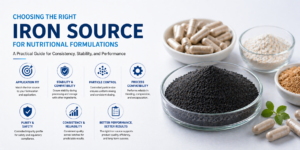
A Practical Guide for Consistency, Stability, and Performance
🔹 Introduction
Selecting the right iron source is one of the most important decisions in developing nutritional formulations. Whether for dietary supplements, premixes, or fortified products, the choice of iron directly impacts product stability, manufacturing efficiency, and overall performance.
Iron is available in multiple forms, each with different characteristics. Choosing the appropriate type requires a clear understanding of application requirements, formulation behavior, and processing conditions.
🔹 Why Iron Source Selection Matters
Iron is not just an ingredient — it is an active functional component within a formulation.
The selected iron source influences:
- Stability of the final product
- Compatibility with other nutrients
- Processing behavior
- Shelf-life performance
- Consistency across production batches
An unsuitable iron source can lead to formulation challenges, quality issues, and production inefficiencies.
🔹 Types of Iron Sources Used in Formulations
🔸 1. Elemental Iron Powders
- Typically used in tablets, capsules, and premixes
- Known for stability and controlled composition
- Suitable for large-scale manufacturing
🔸 2. Iron Salts and Compounds
- Used in various nutritional applications
- May differ in solubility and interaction behavior
Each type has advantages depending on the formulation design and application needs.
🔹 Key Factors to Consider When Choosing an Iron Source
🔸 1. Application Type
Different applications require different material characteristics:
| Application | Key Requirement |
| Tablets | Compressibility & stability |
| Capsules | Flowability & uniformity |
| Premixes | Blending consistency |
| Fortified foods | Compatibility & stability |
🔸 2. Stability Requirements
Iron must remain stable during:
- Processing
- Storage
- Shelf life
Instability can lead to:
- Degradation of other nutrients
- Changes in product quality
🔸 3. Compatibility with Other Ingredients
Iron interacts with:
- Vitamins (especially sensitive ones)
- Other minerals
- Carriers and excipients
A compatible iron source ensures:
- Product integrity
- Consistent formulation behavior
🔸 4. Particle Size & Distribution
Particle size influences:
- Mixing efficiency
- Uniform distribution
- Processing behavior
Controlled particle size helps achieve:
- Better homogeneity
- Reduced segregation
- Consistent dosing
🔸 5. Manufacturing Process Compatibility
Iron must perform reliably during:
- Blending
- Compression
- Encapsulation
Inconsistent materials can lead to:
- Processing difficulties
- Production variability
🔸 6. Impurity Profile & Regulatory Alignment
For food and nutritional applications, iron must meet:
- Purity requirements
- Limits on heavy metals (Pb, As, Hg, Cd)
- Food-grade evaluation standards
Controlled impurity profiles are essential for regulatory compliance and product safety.
🔹 Role of Manufacturing Route in Selection
The method used to produce iron powder significantly impacts its suitability.
Manufacturing route determines:
- Purity
- Consistency
- Surface characteristics
- Stability
Purification-driven processes such as electrolytic refinement typically offer:
- Better impurity control
- Consistent composition
- Reliable performance
🔹 Common Mistakes in Iron Selection
Many formulation challenges arise from incorrect material selection, such as:
- Choosing based only on price
- Ignoring particle size distribution
- Overlooking compatibility with other ingredients
- Relying only on basic specifications
A more informed approach reduces risk and improves product performance.
🔹 Practical Approach to Selecting Iron
A structured selection approach includes:
- Define application requirements
- Evaluate formulation composition
- Assess stability needs
- Review manufacturing process compatibility
- Verify impurity profile and compliance
- Test performance in real conditions
This ensures alignment between material and application.
🔹 Benefits of Choosing the Right Iron Source
Correct selection leads to:
- Consistent product quality
- Efficient manufacturing
- Reduced formulation issues
- Stable shelf-life performance
- Improved customer confidence
🔹 Conclusion
Choosing the right iron source is a critical step in developing successful nutritional formulations.
By considering factors such as application requirements, stability, compatibility, particle size, and manufacturing route, manufacturers can ensure reliable and consistent product performance.
A well-selected iron ingredient supports not only formulation success but also long-term product quality and manufacturing efficiency.