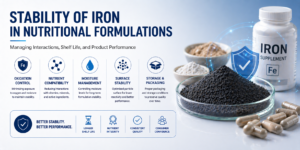
Managing Interactions, Shelf Life, and Product Performance
🔹 Introduction
Iron is an essential component in many nutritional formulations, including dietary supplements, premixes, and fortified products. However, iron is also a chemically active element, which means its stability within a formulation must be carefully managed.
If not properly controlled, iron can interact with other ingredients, affecting product quality, shelf life, and overall performance.
Understanding how to manage iron stability is critical for developing reliable and consistent nutritional products.
🔹 Why Stability Matters
In nutritional formulations, stability directly affects:
- Product shelf life
- Nutrient integrity
- Physical and chemical consistency
- Consumer acceptance
Unstable formulations may result in:
- Degradation of sensitive nutrients
- Changes in product characteristics
- Reduced effectiveness over time
🔹 Factors Affecting Iron Stability
🔸 1. Oxidation Behavior
Iron naturally undergoes oxidation when exposed to:
- Oxygen
- Moisture
- Environmental conditions
This can lead to:
- Changes in surface condition
- Variability in performance
Controlled manufacturing and proper storage help maintain stable behavior over time.
🔸 2. Interaction with Other Nutrients
Iron can interact with:
- Vitamins (especially sensitive ones)
- Other minerals
- Active formulation components
These interactions may:
- Affect stability of other ingredients
- Influence overall product performance
Selecting compatible iron sources reduces these risks.
🔸 3. Moisture Sensitivity
Moisture plays a key role in:
- Accelerating chemical reactions
- Influencing storage stability
Proper control of:
- Packaging
- Storage conditions
- Environmental exposure
is essential for maintaining stability.
🔸 4. Particle Surface Condition
The surface of iron particles influences:
- Reactivity
- Interaction with other ingredients
- Stability during storage
Processes such as controlled hydrogen reduction can improve:
- Surface uniformity
- Stability behavior
🔸 5. Storage and Packaging Conditions
External conditions significantly impact stability:
- Temperature
- Humidity
- Exposure to air
Appropriate packaging and handling practices help preserve product integrity over time.
🔹 Role of Manufacturing in Stability
Manufacturing process directly influences stability through:
- Impurity control
- Surface condition
- Particle consistency
Purification-driven processes tend to produce iron powders with:
- Lower variability
- More controlled behavior
- Better long-term stability
🔹 Stability in Different Applications
Food Fortification
Requires:
- Stability during processing
- Compatibility with food matrix
- Consistent behavior over shelf life
Nutritional Premixes
Requires:
- Stable blending with other micronutrients
- Minimal interaction between components
- Reliable storage performance
Dietary Supplements
Requires:
- Stability in tablets and capsules
- Compatibility with excipients
- Predictable performance during processing
🔹 Common Stability Challenges
Manufacturers may encounter:
- Interaction between iron and vitamins
- Variability during storage
- Moisture-related instability
- Inconsistent performance across batches
These challenges are often linked to material selection and process control.
🔹 Practical Approaches to Improve Stability
To enhance stability, manufacturers should:
- Select iron sources with controlled impurity profiles
- Use materials with stable surface characteristics
- Ensure proper particle size distribution
- Optimize packaging and storage conditions
- Evaluate compatibility within the formulation
🔹 Why Stability is a Selection Factor
Iron selection should not be based only on:
- Iron content
- Cost
- Basic specifications
Stability must be considered as a core selection parameter, especially in:
- Long shelf-life products
- Complex formulations
- Large-scale production
🔹 Conclusion
Iron stability is a critical factor in the success of nutritional formulations. It influences product quality, shelf life, and consistency.
By understanding factors such as oxidation behavior, nutrient interaction, moisture sensitivity, and manufacturing process, manufacturers can design formulations that perform reliably over time.
Selecting the right iron source plays a key role in achieving stable and consistent outcomes.