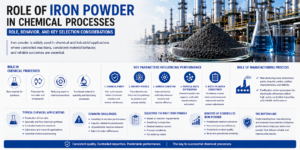
Role, Behavior, and Key Selection Considerations
🔹 Introduction
Iron powder is widely used in chemical and industrial applications where controlled reactions, consistent material behavior, and reliable outcomes are essential.
Unlike food and nutritional applications, where stability and compatibility are primary concerns, chemical applications focus on reactivity, impurity sensitivity, and reproducibility.
The performance of iron powder in these environments depends heavily on its purity, surface condition, particle characteristics, and manufacturing process.
🔹 Role of Iron Powder in Chemical Processes
Iron powder serves multiple functions in chemical applications, including:
- Raw material for synthesis
- Precursor for iron salts and compounds
- Reducing agent in chemical reactions
- Functional material in specialty and laboratory processes
In each of these roles, iron powder must behave predictably and consistently.
🔹 Why Iron Powder Quality Matters
Chemical processes often involve:
- Defined reaction pathways
- Controlled reaction conditions
- Sensitivity to impurities
- Requirement for reproducible results
Variability in iron powder can directly impact:
- Reaction rates
- Yield
- Product quality
- Process efficiency
This makes material selection a critical factor in process performance.
🔹 Key Parameters Influencing Performance
🔸 1. Chemical Purity
High purity iron ensures:
- Minimal interference in reactions
- Better control over outcomes
- Reduced variability
Impurities can alter reaction behavior and affect final product quality.
🔸 2. Impurity Profile
Trace elements can influence:
- Reaction pathways
- Formation of unwanted by-products
- Overall process stability
Controlled impurity levels are essential for predictable chemical performance.
🔸 3. Surface Condition
The surface of iron particles plays a key role in:
- Reactivity
- Interaction with reactants
- Reaction efficiency
Processes such as hydrogen reduction can improve surface uniformity and stability.
🔸 4. Particle Size and Distribution
Particle size affects:
- Surface area available for reaction
- Reaction rate
- Process control
Consistent particle size distribution supports reproducible reaction behavior.
🔸 5. Batch-to-Batch Consistency
Consistency is critical in industrial operations.
Variations between batches can lead to:
- Process adjustments
- Inconsistent output
- Reduced efficiency
Reliable manufacturing ensures stable performance over time.
🔹 Role of Manufacturing Process
The method used to produce iron powder directly influences its behavior in chemical applications.
Manufacturing route determines:
- Purity level
- Impurity control
- Surface characteristics
- Structural stability
Purification-driven processes, such as electrolytic refinement, offer:
- High and consistent purity
- Controlled impurity profiles
- Stable and predictable material behavior
🔹 Typical Chemical Applications
Iron powder is used in:
- Production of iron salts
- Specialty and fine chemical synthesis
- Controlled reduction reactions
- Laboratory and research applications
- Industrial chemical processing
Each application requires alignment between material properties and process conditions.
🔹 Common Challenges in Chemical Use
Chemical users may face challenges such as:
- Variability in reaction performance
- Impurity-related inconsistencies
- Unpredictable reaction behavior
- Batch-to-batch differences
These challenges are often linked to material inconsistency and manufacturing variability.
🔹 Selecting the Right Iron Powder
Selection should be based on:
- Reaction requirements
- Sensitivity to impurities
- Desired reaction control
- Process conditions
- Consistency requirements
Evaluating manufacturing method and material characteristics is essential for reliable performance.
🔹 Benefits of Controlled Iron Powder
Using well-controlled iron powder provides:
- Predictable reaction outcomes
- Improved process efficiency
- Consistent product quality
- Reduced operational variability
🔹 Conclusion
Iron powder plays a critical role in chemical and industrial applications, where performance depends on purity, consistency, and controlled material behavior.
Understanding how manufacturing process and material characteristics influence performance allows users to select iron powders that deliver reliable and reproducible results.