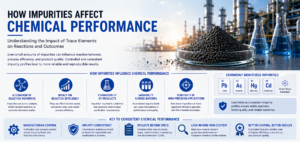
Understanding the Impact of Trace Elements on Reactions and Outcomes
🔹 Introduction
In chemical and industrial applications, the performance of iron powder is not determined by iron content alone. Even small amounts of impurities can significantly influence reaction behavior, product quality, and process consistency.
While impurity levels may fall within acceptable limits, their presence and variability can still affect reaction pathways, efficiency, and reproducibility.
Understanding impurity impact is essential for selecting iron powder that performs reliably in controlled chemical environments.
🔹 What Are Impurities in Iron Powder?
Impurities refer to elements other than iron that are present in small quantities, including:
- Metallic impurities
- Non-metallic residues
- Trace elements introduced during raw material sourcing or processing
In food and chemical applications, commonly monitored impurities include:
- Lead (Pb)
- Arsenic (As)
- Mercury (Hg)
- Cadmium (Cd)
Other non-regulated trace elements may also influence performance.
🔹 Why Impurities Matter in Chemical Applications
Chemical processes often rely on:
- Controlled reaction conditions
- Defined reaction pathways
- Consistent input materials
Impurities can interfere with these conditions, leading to:
- Changes in reaction rates
- Formation of unwanted by-products
- Reduced yield
- Variability in final product quality
🔹 How Impurities Influence Chemical Performance
🔸 1. Alteration of Reaction Pathways
Certain impurities may:
- Act as catalysts
- Inhibit desired reactions
- Promote alternative reaction routes
This can result in:
- Unexpected outcomes
- Reduced process predictability
🔸 2. Impact on Reaction Efficiency
Impurities can affect:
- Reaction speed
- Conversion rates
- Process efficiency
Even minor variations may require:
- Process adjustments
- Additional controls
🔸 3. Formation of By-Products
Uncontrolled impurity profiles may lead to:
- Undesired side reactions
- Formation of impurities in final products
- Additional purification requirements
🔸 4. Variability Across Batches
Inconsistent impurity levels between batches can cause:
- Fluctuations in reaction performance
- Inconsistent product output
- Difficulty in process standardization
🔸 5. Sensitivity in High-Precision Applications
In specialty and fine chemical applications:
- Even trace impurities can have significant effects
- High-purity materials are often required
Controlled impurity profiles are critical for precision and reproducibility.
🔹 Regulated vs Non-Regulated Impurities
🔸 Regulated Impurities
These include:
- Lead (Pb)
- Arsenic (As)
- Mercury (Hg)
- Cadmium (Cd)
They are monitored for:
- Safety
- Compliance
🔸 Non-Regulated Impurities
These may not be strictly regulated but can still affect:
- Reaction behavior
- Process efficiency
- Product consistency
Understanding both categories is important for complete material evaluation.
🔹 Role of Manufacturing in Impurity Control
The manufacturing process determines:
- Type of impurities present
- Level of impurity control
- Consistency across batches
Purification-driven processes such as electrolytic refinement enable:
- Better impurity removal
- Controlled impurity profiles
- Higher consistency
This supports more predictable chemical performance.
🔹 Why Impurity Consistency Matters
It is not only the level of impurities that matters — it is also their consistency.
Consistent impurity profiles ensure:
- Stable reaction conditions
- Repeatable process outcomes
- Reduced need for process adjustments
🔹 Practical Considerations for Buyers
When evaluating iron powder for chemical applications, consider:
- Total impurity levels
- Type of impurities present
- Batch-to-batch consistency
- Manufacturing process used
- Availability of documentation (CoA)
Looking beyond basic specifications helps ensure reliable long-term performance.
🔹 Common Misconception
A common assumption is that if iron content is high, the material will perform well.
However:
- High iron content does not guarantee controlled impurity behavior
- Trace elements can still influence performance
Material evaluation must consider complete chemical profile, not just iron percentage.
🔹 Conclusion
Impurities play a critical role in determining how iron powder performs in chemical applications. Even small variations can influence reaction pathways, efficiency, and product quality.
By selecting iron powder with controlled and consistent impurity profiles, manufacturers can achieve more reliable and reproducible process outcomes.