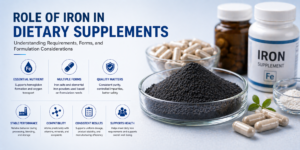
Understanding Requirements, Forms, and Formulation Considerations
🔹 Introduction
Iron plays an essential role in human health, particularly in the formation of hemoglobin and oxygen transport in the body.
Due to the prevalence of iron deficiency, dietary supplements are widely used to support individual nutritional needs, especially in:
- Women of reproductive age
- Pregnant individuals
- Children and adolescents
- Individuals with increased iron requirements
However, the effectiveness of iron supplementation depends not only on dosage but also on the form and quality of the iron used in the formulation.
🔹 Why Iron is Important in Supplements
Iron supports:
- Oxygen transport in blood
- Energy metabolism
- Cognitive function
- Overall physiological health
👉 Insufficient iron intake can lead to iron deficiency and anemia.
🔹 Forms of Iron Used in Supplements
Iron in supplements is available in different forms, including:
🔸 Iron Salts (Commonly Used)
- Ferrous sulfate
- Ferrous fumarate
- Ferrous gluconate
👉 Widely used due to established application and regulatory familiarity
🔸 Elemental Iron Powders
Used in certain formulations depending on:
- Formulation design
- Processing requirements
- Regulatory considerations
👉 Selection depends on application-specific needs
🔹 Key Requirements for Iron in Supplement Formulations
Iron used in supplements must demonstrate:
✔ Consistent Chemical Composition
Ensures predictable dosage and formulation stability
✔ Controlled Impurity Profile
Important for safety and regulatory compliance
✔ Stability During Processing
Must perform reliably during:
- Blending
- Compression
- Encapsulation
✔ Compatibility with Other Ingredients
Iron must interact predictably with:
- Vitamins
- Minerals
- Excipients
🔹 Role of Iron Powder in Supplement Manufacturing
Elemental iron powders may be used in selected dietary supplement formulations, particularly where:
- Controlled particle characteristics are required
- Stable iron forms are preferred
- Specific formulation approaches are used
👉 Use depends on formulation design and regulatory framework.
🔹 Manufacturing Considerations
Supplement production involves:
- Mixing and blending
- Tablet compression or capsule filling
- Packaging and storage
Iron materials used must demonstrate:
- Consistency across batches
- Stable behavior during processing
- Predictable interaction with formulation components
🔹 Importance of Material Quality
The quality of iron used in supplements influences:
- Product stability
- Manufacturing efficiency
- Consistency of dosage
- Overall product reliability
👉 Materials produced through controlled manufacturing processes provide better predictability.
🔹 Serena Nutrition Approach
Serena Nutrition manufactures iron powders with a focus on:
- Electrolytic refinement for purity
- Controlled impurity profile
- Consistent particle characteristics
- Optional hydrogen reduction for enhanced stability
👉 Our materials may be used in selected nutritional formulations, depending on application requirements.
🔹 Important Clarification
❗ Not all iron powders are suitable for dietary supplements.
👉 Selection depends on:
- Formulation design
- Regulatory requirements
- Application-specific performance
🔹 Key Takeaways
- Iron is a critical micronutrient in dietary supplements
- Multiple iron forms are used depending on formulation
- Material quality and consistency are essential
- Elemental iron powders may be used in selected applications