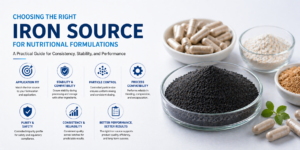
A Practical Guide for Food Fortification, Premix & Industrial Use
🔹 Introduction
Selecting the right iron powder is not just a technical decision — it directly impacts:
- Product performance
- Manufacturing efficiency
- Stability and shelf life
- Regulatory acceptance
In applications such as wheat flour fortification and nutritional premixes, the choice of iron powder plays a critical role in ensuring consistent and reliable outcomes.
👉 The key is not just what iron is used, but how that iron is manufactured.
🔹 Step 1: Define Your Application
Start by identifying where the iron powder will be used:
🥖 Food Fortification (Wheat Flour)
- Requires consistency across large batches
- Needs compatibility with flour systems
- Demands controlled impurity levels
🧪 Nutritional Premix
- Requires uniform blending
- Needs stable interaction with micronutrients
- Must prevent segregation
💊 Nutritional Formulations (Selective Use)
- Requires consistency and stability
- Depends on formulation design
⚗️ Chemical / Industrial Applications
- Requires predictable reaction behavior
- Needs controlled impurity profile
👉 Each application has different priorities.
🔹 Step 2: Understand Manufacturing Route
Iron powder quality is defined by how it is produced.
🔸 Electrolytic Iron Powder
- Produced through electrochemical refinement
- High purity and controlled impurity profile
- Consistent batch performance
🔸 Hydrogen-Reduced Iron (Electrolytic Base)
- Derived from electrolytically refined iron
- Undergoes controlled hydrogen reduction
- Improves:
- Surface uniformity
- Stability
- Storage behavior
👉 This is a value-added step, not ore-based reduction.
🔸 Ore-Based Reduced Iron (DRI-Type)
- Produced directly from iron ore
- Impurity profile depends on raw material
- Greater variability
👉 Typically used in general industrial applications.
🔹 Step 3: Evaluate Key Technical Parameters
✔ Iron Purity
Higher purity supports better consistency and control
✔ Impurity Profile
Critical for:
- Food applications
- Regulatory compliance
✔ Particle Size Distribution
Important for:
- Mixing behavior
- Premix performance
- Flowability
✔ Surface Condition
Impacts:
- Stability
- Reactivity
- Shelf-life behavior
✔ Batch Consistency
Essential for:
- Large-scale production
- Repeatability
🔹 Step 4: Match Iron Type to Application
| Application | Recommended Approach |
| Wheat Flour Fortification | Electrolytic Iron |
| Nutritional Premix | Electrolytic Iron / Hydrogen-Reduced Iron |
| Stability-Sensitive Systems | Hydrogen-Reduced Iron |
| General Industrial Use | Depends on process (including ore-based iron) |
👉 Selection depends on formulation and processing conditions.
🔹 Step 5: Consider Stability & Storage
Iron powders behave differently over time depending on:
- Surface condition
- Storage environment
- Packaging quality
Hydrogen-reduced iron helps:
- Improve surface stability
- Reduce variability during storage
- Support long-term consistency
🔹 Common Mistakes to Avoid
❌ Selecting based on price alone
❌ Ignoring manufacturing route
❌ Assuming all “reduced iron” is the same
❌ Overlooking batch consistency
🔹 Serena Nutrition Approach
At Serena Nutrition, iron powder selection is supported by:
- Electrolytic refinement for purity and control
- Optional hydrogen reduction for stability enhancement
- Consistent manufacturing processes
- Transparent technical documentation
👉 Designed for applications where reliability matters more than appearance.
🔹 Decision Checklist
Before selecting iron powder, ask:
- What is my application?
- Do I need high consistency?
- Is stability important?
- How sensitive is my process to impurities?
- Do I need long-term supply reliability?
🔹 Key Takeaways
- Manufacturing route defines iron powder performance
- Not all iron powders are equivalent
- Electrolytic-based materials offer better control
- Hydrogen reduction enhances stability
- Application-specific selection is critical