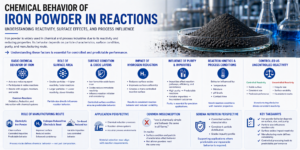
Understanding Reactivity, Surface Effects, and Process Influence
🔹 Introduction
Iron powder is widely used in chemical and process industries due to its reactivity and reducing properties. However, its behavior in reactions is not uniform — it depends heavily on:
- Particle characteristics
- Surface condition
- Purity
- Manufacturing route
👉 Understanding these factors is essential for selecting the right iron powder for controlled and predictable chemical performance.
🔹 Basic Chemical Behavior of Iron
Iron is a reactive metal that can:
- Act as a reducing agent
- Participate in oxidation-reduction (redox) reactions
- React with oxygen, moisture, and acids
Common Reactions:
- Oxidation (formation of iron oxides)
- Reduction of other compounds
- Interaction with aqueous and chemical systems
🔹 Role of Surface Area
Smaller Particles → Higher Reactivity
- Increased surface area
- More contact with reactants
- Faster reaction rates
Larger Particles → Lower Reactivity
- Reduced surface exposure
- Slower reaction kinetics
👉 Particle size directly influences how iron behaves in chemical processes.
🔹 Surface Condition and Oxide Layers
Iron particles naturally develop thin oxide layers when exposed to air.
Effects of Surface Oxides:
- Reduce immediate reactivity
- Influence reaction initiation
- Affect consistency
👉 Controlled surface condition is critical for predictable behavior.
🔹 Impact of Hydrogen Reduction
Hydrogen reduction plays a key role in modifying surface properties.
Effects:
- Reduces residual surface oxides
- Improves surface uniformity
- Creates a more controlled reactive surface
👉 This results in:
- More consistent reaction behavior
- Reduced variability across batches
🔹 Influence of Purity and Impurities
Impurities can affect:
- Reaction pathways
- Efficiency
- Consistency
High-Purity Iron:
- Predictable reactions
- Controlled performance
Variable Impurity Iron:
- Inconsistent outcomes
- Uncontrolled behavior
👉 Purity is essential in applications requiring precision.
🔹 Reaction Kinetics and Process Conditions
Iron powder behavior is influenced by:
- Temperature
- Moisture
- pH levels
- Contact time
👉 Reaction conditions must be matched with material properties.
🔹 Controlled vs Uncontrolled Reactivity
Controlled Reactivity
- Stable surface condition
- Consistent particle size
- Predictable performance
Uncontrolled Reactivity
- Irregular particle distribution
- Surface variability
- Inconsistent results
👉 Manufacturing discipline plays a major role here.
🔹 Role of Manufacturing Route
Electrolytic Iron Powder
- Clean, refined iron surface
- Controlled impurity profile
- Predictable chemical behavior
Hydrogen-Reduced Iron (Electrolytic Base)
- Improved surface condition
- Reduced oxide layers
- Enhanced consistency
Ore-Based Reduced Iron
- Variable impurity profile
- Less controlled behavior
👉 Process route defines chemical behavior — not just composition.
🔹 Application Perspective
Iron powder behavior is relevant in:
- Chemical reduction processes
- Reaction-driven systems
- Industrial process environments
👉 Material selection must align with reaction requirements.
🔹 Common Misconception
❌ “Iron is chemically simple and behaves the same in all forms”
✅ In reality:
- Surface condition and particle characteristics significantly affect behavior
- Not all iron powders react the same way
🔹 Serena Nutrition Perspective
Serena Nutrition focuses on producing iron powders with:
- Controlled surface characteristics
- Consistent particle distribution
- Stable impurity profile
👉 Supporting applications where predictable and repeatable behavior is required
🔹 Key Takeaways
- Iron powder behavior depends on surface, size, and purity
- Particle size influences reaction rate
- Surface oxides impact reactivity
- Manufacturing route defines consistency
- Controlled processing leads to predictable performance