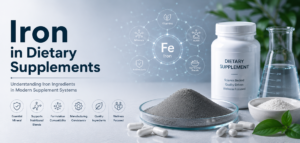
Understanding Ingredient Stability in Supplement & Wellness Systems
🔹 Introduction
Stability is one of the most important technical considerations in nutritional formulations.
Modern supplement and wellness products are expected to maintain:
- Nutritional consistency
- Reliable formulation performance
- Product quality
- Sensory stability
- Shelf-life integrity
Nutritional systems often contain multiple ingredients within a single formulation, making stability an important factor throughout manufacturing, storage, transportation, and product use.
Iron-containing nutritional formulations may therefore be evaluated for:
- Ingredient compatibility
- Moisture sensitivity
- Oxidation behavior
- Particle characteristics
- Storage performance
- Manufacturing consistency
Controlled ingredient systems help support more reliable nutritional products.
🔹 Why Stability Matters in Nutritional Systems
Nutritional products may be exposed to:
- Moisture
- Oxygen exposure
- Temperature variation
- Packaging environments
- Transportation conditions
- Long-term storage
Instability within formulations may influence:
- Product consistency
- Nutritional reliability
- Sensory characteristics
- Shelf-life performance
- Manufacturing reproducibility
Stable ingredient systems help support dependable supplement and wellness products.
🔹 Ingredient Compatibility and Stability
Nutritional formulations often combine:
- Vitamins
- Minerals
- Functional nutrients
- Botanical ingredients
- Micronutrient blends
Interactions between ingredients may influence:
- Formulation behavior
- Product stability
- Nutrient consistency
- Storage performance
Iron ingredients may therefore be evaluated for compatibility with surrounding formulation systems.
Reliable compatibility helps support more stable nutritional products.
🔹 Role of Particle Characteristics
Particle size and particle distribution may influence:
- Blending behavior
- Flow performance
- Ingredient dispersion
- Premix consistency
- Storage stability
Controlled particle systems help support more predictable formulation performance during processing and storage.
🔹 Moisture and Oxygen Exposure
Environmental exposure may influence ingredient behavior within nutritional systems.
Factors commonly considered include:
- Humidity exposure
- Oxygen interaction
- Packaging protection
- Temperature conditions
- Shelf-life environments
Stable ingredient systems help support:
- Reliable product quality
- Controlled formulation behavior
- Long-term storage consistency
Packaging systems therefore play an important role in nutritional product stability.
🔹 Stability in Premix Systems
Many nutritional products use vitamin and mineral premixes before final manufacturing.
Premix stability may influence:
- Nutrient distribution
- Ingredient interaction
- Product consistency
- Manufacturing reliability
Controlled manufacturing systems help support dependable premix performance during storage and processing.
🔹 Sensory Stability in Nutritional Products
Ingredient systems may influence:
- Product appearance
- Taste behavior
- Color stability
- Consumer acceptance
Nutritional formulations are commonly designed to balance:
- Technical performance
- Stability requirements
- Sensory consistency
- Product quality expectations
Controlled ingredient systems help support more stable nutritional formulations.
🔹 Importance of Manufacturing Consistency
Reliable nutritional systems require ingredients manufactured with:
- Controlled impurity profiles
- Stable particle characteristics
- Reproducible manufacturing quality
- Reliable formulation behavior
Manufacturing route and process discipline may significantly influence ingredient performance within nutritional systems.
🔹 Stability Across Product Life Cycle
Nutritional products must maintain performance throughout:
- Manufacturing
- Packaging
- Transportation
- Warehousing
- Retail storage
- Consumer handling
Stable ingredient systems help support dependable nutritional product performance throughout the product life cycle.
🔹 Modern Nutritional Product Systems
Stability-focused formulation systems are commonly used in:
- Dietary supplements
- Nutraceutical products
- Wellness-focused formulations
- Functional nutrition applications
- Nutritional premixes
As nutritional industries continue to evolve, stability and formulation consistency remain important parts of dependable product development.
🔹 Serena Nutrition Perspective
At Serena Nutrition, we manufacture high-purity iron powders designed for nutritional, food fortification, and specialty applications.
Our approach emphasizes:
- Controlled manufacturing systems
- Stable particle characteristics
- Consistent product quality
- Reliable formulation performance
- Food-grade process standards
We believe stability, ingredient quality, and process discipline are essential foundations of dependable nutritional systems.
🔹 Key Takeaways
- Stability is critical in nutritional formulation systems
- Nutritional products must maintain consistency throughout shelf life
- Ingredient compatibility influences formulation stability
- Particle characteristics affect storage and processing behavior
- Premix systems require stable ingredient performance
- Sensory consistency influences product quality and acceptance
- Controlled manufacturing helps support dependable nutritional formulations