Understanding Functional Uses Across Chemical and Process Industries
🔹 Introduction
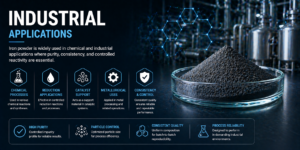
Iron powder is widely used across various industrial applications due to its reactivity, availability, and functional versatility.
While different grades of iron powder are used depending on the application, the performance of iron powder in industrial processes is strongly influenced by its manufacturing route, purity, and particle characteristics.
👉 Understanding how iron behaves in industrial environments helps in selecting the right material for specific process requirements.
🔹 Why Iron Powder is Used in Industrial Applications
Iron powder is valued for:
- Controlled reactivity
- Reducing properties
- Surface interaction capability
- Availability in different particle sizes
👉 These properties make it suitable for a range of chemical and industrial processes.
🔹 Key Industrial Uses of Iron Powder
1️ Chemical Reactions & Reduction Processes
Iron powder is used as a reducing agent in various chemical reactions.
👉 It participates in:
- Reduction reactions
- Removal of unwanted elements
- Controlled transformation processes
2️ Water Treatment (Selected Applications)
Iron powder can be used in certain treatment systems for:
- Removal of contaminants
- Reduction of specific compounds
👉 Application depends on process design and system requirements
3️ Powder Metallurgy
Used in:
- Metal component manufacturing
- Pressing and sintering processes
👉 Requires controlled particle size and consistency
4️ Specialty Chemical Applications
Iron powder is used where:
- Controlled surface reactions are required
- Predictable chemical behavior is important
🔹 Key Properties That Matter in Industrial Use
✔ Particle Size Distribution
- Influences reaction rate
- Affects processing behavior
✔ Surface Area
- Determines reactivity
- Impacts efficiency of reactions
✔ Purity & Impurity Profile
- Affects consistency
- Important for controlled processes
✔ Flowability
- Critical for handling and dosing
🔹 Role of Manufacturing Route
Different production methods result in different material characteristics.
Electrolytic Iron Powder
- High purity
- Controlled impurity profile
- Consistent behavior
👉 Suitable for applications requiring precision and reliability
Hydrogen-Reduced Iron (Electrolytic Base)
- Improved surface condition
- Reduced oxides
- Enhanced stability
👉 Useful where controlled surface behavior is important
Ore-Based Reduced Iron
- Derived from iron ore
- May have higher variability
👉 Often used in general industrial applications
🔹 Matching Iron Powder to Industrial Application
Selection depends on:
- Reaction sensitivity
- Required consistency
- Process conditions
- Cost-performance balance
👉 Not all industrial applications require the same level of refinement.
🔹 Common Misconception
❌ “All iron powders behave similarly in industrial processes”
✅ In reality:
- Particle characteristics and purity significantly influence performance
- Manufacturing route defines behavior
🔹 Serena Nutrition Perspective
While Serena Nutrition primarily focuses on food and premix applications, our manufacturing approach emphasizes:
- Controlled refinement
- Consistent material properties
- Reliable batch performance
👉 These characteristics are also relevant in selected industrial applications where consistency and predictability are important
🔹 Key Takeaways
- Iron powder is widely used across industrial processes
- Performance depends on particle size, purity, and surface condition
- Manufacturing route influences material behavior
- Application-specific selection is critical