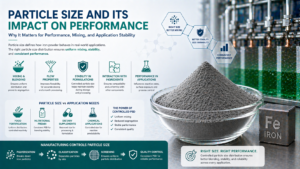
Understanding Its Impact on Performance, Stability, and Application
🔹 Introduction
Particle size is one of the most important — yet often overlooked — parameters in iron powder performance.
While purity and chemical composition are critical, particle size distribution directly influences how iron behaves in processing, storage, and end-use applications.
In food fortification, nutritional premixes, and industrial processes, selecting the right particle size can significantly impact:
- Stability
- Flowability
- Mixing behavior
- Reactivity
- Overall product performance
🔹 What is Particle Size in Iron Powder?
Particle size refers to the physical dimensions of individual iron powder particles, typically measured in microns.
However, in practical applications, what matters more is:
👉 Particle Size Distribution (PSD) — the range and proportion of particle sizes within a batch
🔹 Why Particle Size Matters
Particle size affects multiple functional properties of iron powder:
1️⃣ Surface Area
- Smaller particles → higher surface area
- Higher surface area → increased reactivity
👉 Important for:
- Chemical reactions
- Oxidation behavior
2️⃣ Stability and Oxidation
- Finer particles tend to oxidize faster
- Coarser particles are generally more stable
👉 Balance is required depending on application
3️⃣ Flowability
- Larger, uniform particles → better flow
- Very fine powders → may cause poor flow and dusting
👉 Critical for:
- Premix manufacturing
- Automated dosing systems
4️⃣ Mixing Behavior
- Controlled particle size → uniform blending
- Wide variation → segregation risks
👉 Important in:
- Nutritional premixes
- Fortified food production
5️⃣ Sensory Impact in Food
Particle size can influence:
- Mouthfeel
- Texture perception
- Visual appearance
👉 Especially relevant in food fortification
🔹 Particle Size in Food Fortification
In food applications, particle size must be carefully selected to ensure:
- Minimal impact on taste and texture
- Uniform dispersion in food matrix
- Stable performance during storage
👉 Overly fine particles may increase reactivity
👉 Overly coarse particles may affect texture
🔹 Particle Size in Nutritional Premixes
Premix manufacturing requires:
- Consistent particle size distribution
- Good flowability
- Minimal segregation
👉 This ensures:
- Accurate dosing
- Uniform nutrient distribution
🔹 Particle Size in Industrial Applications
In industrial and chemical applications:
- Smaller particles → faster reaction rates
- Controlled particle size → predictable behavior
👉 Selection depends on process requirements
🔹 Relationship Between Particle Size and Manufacturing
Particle size is not just a post-processing parameter — it is influenced by:
- Production method
- Pulverization techniques
- Classification processes
Iron powders produced through controlled manufacturing routes allow:
- Better particle size control
- Narrow distribution ranges
- Consistent batch quality
🔹 Serena Nutrition Approach
At Serena Nutrition:
- Particle size is controlled based on application requirements
- Distribution is managed through classification and process control
- Specifications are aligned with real-world use, not over-defined unnecessarily
We focus on:
- Consistency across batches
- Functional performance in application
- Compatibility with customer processes
🔹 Common Misconception
❌ “Finer particle size is always better”
✅ In reality:
- Optimal particle size depends on application
- Excessively fine powders can reduce stability and flow
🔹 How to Choose the Right Particle Size
Selection depends on:
- Application type (food, premix, industrial)
- Processing method
- Stability requirements
- Flow and mixing behavior
👉 A balanced approach is essential — not simply “finer” or “coarser”
🔹 Why Consistency Matters More Than Size Alone
Even more important than average particle size is:
👉 Consistency of particle size distribution across batches
This ensures:
- Predictable performance
- Reliable processing
- Reduced variability