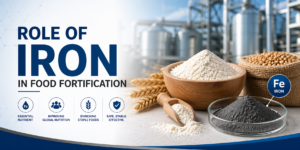
Importance, Function, and Impact in Global Nutrition Programs
🔹 Introduction
Iron is an essential micronutrient required for several critical biological functions, including oxygen transport, energy metabolism, and cognitive development. Despite its importance, iron deficiency remains one of the most widespread nutritional challenges globally, affecting millions of people across both developing and developed regions.
Food fortification has emerged as a practical and scalable solution to address this issue by enriching commonly consumed foods with iron. The effectiveness of these programs depends not only on the inclusion of iron, but also on the quality, stability, and consistency of the iron source used.
🔹 Why Iron is Essential for Human Health
Iron plays a vital role in the human body:
- Supports the formation of hemoglobin, which carries oxygen in the blood
- Contributes to normal energy production and metabolism
- Supports cognitive function and physical performance
- Plays a role in immune system function
Insufficient iron intake can lead to iron deficiency anemia, reduced productivity, fatigue, and impaired development, particularly in children and women.
🔹 Global Need for Iron Fortification
Iron deficiency is recognized as one of the most common micronutrient deficiencies worldwide.
Key contributing factors include:
- Limited dietary diversity
- Low intake of iron-rich foods
- Poor absorption of dietary iron
- Increased nutritional requirements in certain populations
Food fortification programs aim to address these gaps by delivering iron through regularly consumed staple foods, ensuring consistent intake across populations.
🔹 How Food Fortification Works
Food fortification involves adding essential micronutrients, such as iron, to widely consumed foods including:
- Wheat flour
- Rice
- Cereal products
- Other staple foods
This approach ensures that individuals receive iron as part of their daily diet without requiring changes in eating habits.
The success of fortification depends on:
- Uniform distribution of iron in food
- Stability during processing and storage
- Consistent performance across production batches
🔹 Role of Iron Powder in Fortification Systems
Iron powders are widely used in food fortification due to their ability to be incorporated into dry food systems and industrial processing environments.
In these applications, iron powder must meet several key requirements:
Safety for Regular Consumption
Iron used in food must comply with food-grade standards and safety parameters.
Chemical Stability
It should remain stable during processing, storage, and shelf life.
Compatibility with Food Products
Iron should not negatively affect taste, color, or texture of food.
Consistency in Supply
Uniform quality across batches is critical for large-scale fortification programs.
The performance of iron powder is influenced by manufacturing route, impurity profile, and particle characteristics, rather than appearance alone.
🔹 Importance of Iron Quality in Fortification
The quality of iron used in fortification directly impacts:
- Product stability
- Consumer acceptance
- Regulatory compliance
- Long-term program effectiveness
Poor-quality iron sources can lead to:
- Sensory issues in food
- Inconsistent nutrient delivery
- Variability in production
This highlights the importance of selecting iron powders that are well-refined, consistent, and suitable for the intended application.
🔹 Manufacturing Matters More Than Appearance
Iron powders may look similar visually, but their performance varies significantly based on how they are produced.
Manufacturing methods such as electrolytic refinement allow:
- Better control over purity
- Reduced impurity levels
- Consistent chemical composition
- Reliable batch-to-batch performance
This makes manufacturing route a critical factor in selecting iron for food fortification.
🔹 Conclusion
Iron plays a central role in improving nutritional outcomes through food fortification. However, the success of fortification programs depends not just on adding iron, but on selecting the right type of iron with controlled quality and consistent performance.
By focusing on purity, stability, and process-driven manufacturing, iron powders can support effective, scalable, and reliable fortification systems across global markets.