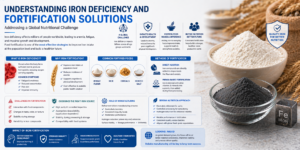
Addressing a Global Nutritional Challenge
🔹 Introduction
Iron deficiency is one of the most widespread nutritional challenges globally, affecting millions of people across both developing and developed countries.
It is a leading cause of anemia, impacting:
- Women of reproductive age
- Children and adolescents
- Pregnant women
- Populations with limited access to diverse diets
Addressing iron deficiency is not only a health priority but also a social and economic necessity, influencing productivity, cognitive development, and overall well-being.
🔹 What is Iron Deficiency?
Iron deficiency occurs when the body does not have sufficient iron to produce hemoglobin, the protein in red blood cells responsible for carrying oxygen.
Common Causes:
- Inadequate dietary intake
- Poor iron absorption
- Increased physiological demand (pregnancy, growth)
- Blood loss
Common Symptoms:
- Fatigue and weakness
- Reduced concentration
- Pale skin
- Impaired immunity
🔹 Global Impact of Iron Deficiency
Iron deficiency remains one of the most prevalent micronutrient deficiencies worldwide.
It affects:
- Public health systems
- Workforce productivity
- Child development outcomes
👉 Many countries have implemented food fortification programs as a scalable and cost-effective solution.
🔹 What is Food Fortification?
Food fortification is the process of adding essential micronutrients to commonly consumed foods to improve their nutritional value.
Common Fortified Foods:
- Wheat flour
- Rice
- Cereals
- Salt (iodized salt as an example)
Iron fortification is one of the most widely adopted strategies due to the high prevalence of iron deficiency.
🔹 Why Iron Fortification is Important
Iron fortification helps:
- Improve iron intake at a population level
- Reduce incidence of anemia
- Support cognitive and physical development
- Enhance public health outcomes
👉 It is especially effective because it integrates nutrition into daily food consumption habits
🔹 Methods of Iron Fortification
1️⃣ Direct Addition
Iron compounds are directly added to staple foods such as flour and cereals.
2️⃣ Premix-Based Fortification
Iron is blended with other vitamins and minerals into a nutritional premix, which is then added during food processing.
👉 This is the most common approach in industrial food systems.
🔹 Role of Iron Powders in Fortification
Iron powders are widely used in fortification due to their stability and compatibility with food systems.
Key considerations include:
- Purity of iron
- Particle size
- Stability in food matrix
- Minimal impact on taste, color, and texture
- Consistent performance
👉 The choice of iron material significantly influences fortification success.
🔹 Challenges in Iron Fortification
Despite its benefits, iron fortification presents several challenges:
- Interaction with food components
- Changes in taste or color
- Stability during storage
- Variability in iron compounds
👉 These challenges highlight the importance of material selection and process control
🔹 Choosing the Right Iron Source
The effectiveness of fortification depends on selecting the appropriate iron material.
Key Factors:
- Purity and impurity profile
- Bioavailability (application-dependent)
- Stability during processing and storage
- Compatibility with food system
👉 Materials derived from controlled manufacturing processes offer better consistency and reliability.
🔹 Role of Manufacturing in Fortification Performance
Iron powders produced through refinement-driven processes, such as electrolytic iron, provide:
- Controlled chemistry
- Consistent impurity levels
- Predictable behavior in formulations
Further processing, such as hydrogen reduction, can enhance:
- Surface stability
- Storage performance
- Uniformity
👉 Manufacturing route directly impacts application performance.
🔹 Serena Nutrition Approach
At Serena Nutrition, iron powders are developed with a focus on:
- Electrolytic refinement for purity
- Controlled processing for consistency
- Hydrogen reduction for enhanced stability (where required)
This approach supports:
- Reliable performance in food fortification
- Consistent quality across batches
- Alignment with global food-grade expectations
🔹 Looking Ahead
Food fortification will continue to play a critical role in addressing global iron deficiency.
As demand grows, the focus will increasingly shift toward:
- Better material consistency
- Improved stability
- Process-driven quality
👉 Reliable manufacturing will be key to long-term success.